

Is American Eagle a fast fashion brand?

American Eagle remains a popular name in casual fashion across the USA. Many shoppers love its trendy jeans and affordable style. Yet, questions about sustainability continue to grow. This American Eagle ethical review explores whether the brand meets modern expectations. Today, buyers care more about eco-friendly clothing brands and responsible choices.
Concerns about fast fashion’s environmental impact are rising fast. People now compare brands based on fashion brand transparency and long-term impact. This shift pushes companies to improve their actions. In this guide, you will discover how American Eagle performs and whether it stands among responsible clothing brands in today’s changing fashion industry.
American Eagle Sustainability Overview

This American Eagle ethical review shows mixed progress in policies and action. The brand talks about improvement, yet gaps remain in fashion brand transparency and measurable goals. Many claims still lack independent verification, which makes trust harder for careful shoppers.
Modern buyers expect strong corporate social responsibility in fashion today. However, without clear timelines, promises feel incomplete. Stronger, sustainable production practices and better reporting would improve its American Eagle sustainability rating and align with growing expectations in the green fashion movement.
Environmental Impact of American Eagle
The environmental impact of clothing brands remains a major concern here. The company uses some recycled materials in fashion, yet overall usage stays limited. Its actions do not fully address hazardous chemicals in clothing production or the wider biodiversity impact of the fashion industry. Efforts toward sustainable cotton sourcing appear unclear without deadlines. That weakens trust in ethical sourcing claims for raw materials. Many eco-friendly clothing brands now lead with clearer goals, while this brand still struggles.
| Factor | American Eagle Status | Industry Expectation |
| Materials | Partial use | High recycled usage |
| Emissions | Targets set | Proven reduction |
| Chemicals | Limited action | Full elimination |
Labor Conditions and Worker Rights
Labor concerns remain serious in this American Eagle ethical review. There is little proof of a living wage in the garment industry across its supply chain. Weak reporting raises questions about labor rights in textile factories and overall worker safety.
Experts highlight major global fashion supply chain issues here. Without audits or certifications, supply chain transparency in fashion stays low. Stronger systems would improve trust and align with expectations for responsible clothing brands in modern markets.
Animal Welfare Policy
Animal care also needs attention in this American Eagle sustainability review. The brand mentions standards but lacks proof. This raises concerns about animal welfare in fashion brands and real implementation of humane policies.
Claims about non-mulesed wool sourcing sound positive but remain unverified. Without clear audits, buyers question reliability. Strong policies and public proof would help meet expectations for ethical buyers choosing eco-conscious fashion choices today.
Overall Ethical Rating: Is American Eagle Good or Bad?
Looking at all factors, the brand’s sustainability rating stays below expectations. Good On You — the independent rating platform this site already links to — rates American Eagle “Not Good Enough” overall in its June 2025 rating, with the same “Not Good Enough” score for planet, people, and animals. Progress exists, yet gaps remain in the environment, labor, and transparency. Many experts compare it with leading ethical clothing companies in 2026, where it falls behind. The brand must improve its sustainability practices and reporting. Without stronger action, it struggles to compete with the top clothing brands’ ethical ratings. This result shows the gap between promises and actual impact.
Best Ethical Alternatives to American Eagle
Shoppers now explore ethical fashion brands’ alternatives for better impact. Many sustainable jeans brands focus on quality, transparency, and long-term value. These brands lead the shift toward affordable sustainable fashion without harming the planet.
Several brands now offer clearly better practices than American Eagle. They use certified materials and strong labor policies — and the ratings prove it. Levi’s scores “It’s a Start” overall from Good On You, a step above American Eagle, while Patagonia scores “Good.” For pure denim, Nudie Jeans and MUD Jeans both earn Good On You’s top “Great” rating.
American Eagle vs H&M, Zara & Aerie: Ethics Comparison
The American Eagle ethical question gets a lot clearer when you line the brand up against the stores you actually shop at. Here is how AE stacks up against H&M, Zara, and its own sister brand Aerie. Ratings change as brands are re-rated, so treat Good On You as a live scoreboard, not a permanent verdict.
| Brand | Good On You rating | Strongest point | Weakest point | Typical jeans price |
| American Eagle | Not Good Enough (June 2025) | Real Good water-saving denim | No living-wage evidence | ~$50–$80 |
| H&M | It’s a Start | Science-based climate targets | Fast-fashion overproduction model | ~$20–$40 |
| Zara | It’s a Start | Own factories in Spain | 10,000+ new designs a year | ~$30–$50 |
| Aerie (AEO sister brand) | Shares AEO’s supply chain | Real Good materials | Same gaps as AE | ~$30–$70 |
Three things jump out. First, American Eagle actually scores worse than H&M and Zara right now — both rivals sit one rung higher at “It’s a Start,” while AE is still “Not Good Enough.” That surprises a lot of shoppers, because AE feels like the friendlier brand. Feelings are not data, though: the rating reflects published evidence, and AE publishes less proof about its factories and wages.
Second, the gap is not huge. All four brands sell jeans in the same $20–$80 range, and none of them pays a proven living wage across its supply chain. Switching from AE to H&M or Zara is a sideways move, not an upgrade — if you want a real step up, look at Levi’s (“It’s a Start” overall, with a “Good” environment score) or Patagonia (“Good” overall).
Third, Aerie is not an escape hatch. It is AEO’s sister brand, made in the same supply chain under the same Real Good program — same ethics story, different marketing. You can compare all four brands on Amazon Fashion, which stocks AE, Levi’s, and dozens of denim rivals — our Amazon Fashion guide shows how to spot the real deals.
So where does that leave the American Eagle ethical debate? In the middle of the mall: better than ultra-fast-fashion brands like Shein (“We Avoid”), worse than the mid-tier improvers, and a long way from the genuinely good brands.
How to Read AEO’s Sustainability Reports (Without Getting Greenwashed)
When you read any American Eagle ethical claim, ask one question: is this a promise, or is it proof? AEO’s own reports are a decent place to start, because the company does publish real numbers. Here is what those numbers say, and where they stop.
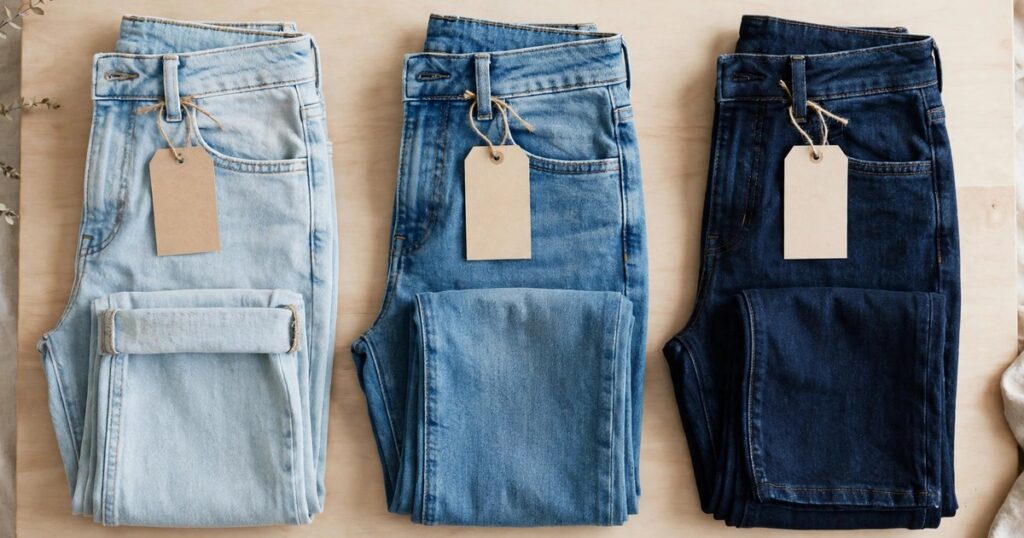
What AEO can prove. The Real Good label is the heart of the program. A Real Good style is made with recycled fibers, Better Cotton, or organic cotton, in factories meeting AEO’s Water Leadership Program standards. AEO reports more than 3.5 billion gallons of water saved in jeans factories since 2017, about 36% less water per pair, and roughly 14 gallons saved on every pair of Real Good jeans. In 2024 it used 635 million recycled plastic bottles’ worth of recycled polyester. Those are real, checkable numbers — genuinely better than most mall brands manage.
Where the proof runs out. AEO set a goal of sourcing 100% of its cotton more sustainably by 2023 — but in 2022 it was only at 65%. Recycled polyester was at 27% against a 50% goal. And while the company talks about cutting emissions, its Scope 3 emissions — the ones from its supply chain, which matter most — actually rose from about 3.14 million metric tons in 2018 to 3.51 million in 2022. On labor, there is no evidence workers making AE clothes earn a living wage. On animals, the non-mulesed wool policy sounds good, but Good On You found no evidence to verify it.
That gap between glossy numbers and missing proof is what makes the American Eagle ethical conversation so confusing — and it is exactly what greenwashing looks like. Use this three-point check before you believe any brand’s sustainability page: (1) look for the label on the actual product — the Real Good badge on the tag, not just on the website; (2) look for dates and baselines — “we cut water 36% since 2017” means something, “we care about water” means nothing; (3) check an independent rater like Good On You before you buy.
Price vs Ethics: What American Eagle Really Costs You
The American Eagle ethical trade-off is real: you pay less upfront, but somebody else pays the difference — usually the garment worker, or the planet. That does not mean never shop at AE. It means know what your money is buying, and what it is not.
Start with cost per wear, the only price that matters. Say you buy AE jeans for $60 and wear them once a week for two years — about 100 wears, or 60 cents a wear. A $25 pair of ultra-cheap jeans that falls apart after 20 wears costs you $1.25 a wear — twice as much, for a worse product. Now compare a $150 pair from a genuinely ethical denim brand, worn once a week for five years: about 58 cents a wear. The ethical pair and the AE pair end up costing almost the same. The cheap pair is the expensive one.
What you are actually paying for at AE is fit, washes, and convenience. What you are not paying for is a verified living wage, a fully traced supply chain, or third-party proof behind most of the claims. That is the deal, stated plainly. If the fit is worth it to you, buy the jeans — but buy them deliberately, not on autopilot.
That is the American Eagle ethical math that matters: the cheapest sticker price is rarely the cheapest jeans, and the most expensive sticker price is rarely the most ethical choice. The sweet spot is a well-made pair you will actually wear for years. If you want the look without the guilt, our 2026 fashion trends guide shows which styles are easiest to find secondhand.
How to Shop American Eagle More Sustainably
You do not have to quit the brand to shrink your American Eagle ethical footprint. If you already love the fit, these five moves cut the impact of every AE purchase without cutting the brand out of your closet.
Buy secondhand first. AE jeans are everywhere on Poshmark, ThredUp, and eBay, usually for $10–$20. A secondhand pair has zero new production impact — the single greenest way to wear AE, and the fit is the same.
Buy Real Good styles only. When you do buy new, check the tag for the Real Good badge. If it is not there, that item is not part of AE’s sustainability program at all — skip it and pick the version that is.
Buy classic, not trendy. A straight-leg jean in a dark wash will still look right in three years. A heavily distressed wash will not — and distressing uses more water and chemicals while weakening the fabric.
Wash cold, hang dry. A Levi’s lifecycle study found 37% of a pair of 501s’ climate impact happens in the washing phase, in your home. Cold water and line drying roughly halve that, and your jeans last longer too.
Repair it, then resell it. A torn knee is a $10 repair, not a reason to bin a $60 pair. When you are done, AE’s Blue Jeans Go Green program has already collected 569,000+ donated jeans — or resell the pair yourself for $10–$15.
What to buy: Real Good straight-leg jeans, classic dark-wash denim, AE’s recycled-fiber basics. What to skip: ultra-trendy washes, heavy distressing, and anything you will not wear at least 30 times. Vintage 90s denim is the easiest sustainable swap of all — our 1990s fashion guide shows the cuts that still look current today.
If you only remember one American Eagle ethical tip, make it this: buy less, wear longer. One pair worn 100 times beats five pairs worn 10 times — for your wallet, and for the planet.
Why Ethical Brand Ratings Matter
Ethical ratings guide smarter choices in a complex market. They highlight real performance behind marketing claims. This supports better responsible fashion purchasing decisions and builds awareness of industry impact.
A good sustainable fashion guide helps you compare brands clearly. It explains data around labor, materials, and emissions. These insights improve trust and push brands toward better fashion brand accountability over time.
Is American Eagle ethical?
Not fully. Good On You rates American Eagle “Not Good Enough” overall (June 2025 rating), with the same score for planet, people, and animals. The brand does real work on water — Real Good jeans save about 14 gallons per pair — but it shows no evidence of paying living wages. The honest American Eagle ethical answer is: better than the worst fast-fashion brands, but not a brand you can shop without thinking.
Is American Eagle a fast fashion brand?
Yes, by most definitions. Its low prices, seasonal trend drops, and high volume put it in the fast-fashion camp — even though it moves slower than Zara or Shein. AE sits in the middle: not ultra-fast fashion, but not slow fashion either.
What does American Eagle’s Real Good label mean?
Real Good marks styles made with recycled fibers, Better Cotton, or organic cotton, in factories meeting AEO’s Water Leadership Program standards. A pair of Real Good jeans saves about 14 gallons of water versus a standard pair. The Real Good label is the easiest American Eagle ethical shortcut when you are standing in the store: if the tag does not say Real Good, that item is not part of AE’s sustainability program at all.
Does American Eagle use sustainable cotton?
Partly. AEO sources cotton through the Better Cotton Initiative plus recycled and organic cotton, and it set a goal of 100% more-sustainably-sourced cotton by 2023. In 2022 it was at 65% — real progress, but short of its own target. If the product page lists Better Cotton or recycled cotton, that pair is a better pick.
What are the best ethical alternatives to American Eagle?
For a real step up, Levi’s scores “It’s a Start” overall from Good On You, Patagonia scores “Good,” and Nudie Jeans and MUD Jeans both earn the top “Great” rating for denim. But the cheapest upgrade is secondhand American Eagle itself — same fit, $10–$20, zero new production.
Should I still buy from American Eagle?
That is your call. If you love the fit and the price, shop Real Good styles, buy secondhand first, and keep each piece for years. That approach makes any American Eagle ethical compromise much smaller — and your cost per wear drops too.
Final Thoughts: Should You Buy From American Eagle?
This American Eagle ethical review shows the brand still has work to do. It offers style and affordability, yet lacks strong ethical progress. Buyers must weigh price against impact when making decisions.

1 thought on “ American Eagle Ethical? A Complete American Eagle Sustainability Review for Smart Shoppers”