

Fashion illustration is an important part of the fashion industry. It helps designers show clothing ideas before making real garments. Through creative fashion drawing, designers can express style, color, and fabric details in a simple visual form. Many designers begin their work with fashion design sketches to explore new ideas and shapes
. These sketches later become part of the complete fashion design process, where concepts turn into real outfits. Learning fashion sketching techniques also helps artists improve their drawing skills and understand clothing structure. In modern times, artists also use digital fashion sketching tools to create professional designs. Fashion illustration is not only an art but also a powerful way to communicate design ideas clearly.
Understanding the Role of Fashion Illustration in the Fashion Industry

Fashion illustration is not only about drawing clothes. It is also a method of communication used throughout the fashion design process. Designers use drawings to explain their ideas to teams, clients, and manufacturers. These illustrations serve as a visual language that supports communication in fashion design. In early design stages, illustrators create rough garment design sketches to explore different shapes and styles. Later, these sketches become refined presentations for fashion sketching meetings. Designers also rely on fashion design collaboration when sharing their ideas with pattern makers, stylists, and production teams.
A strong understanding of the history of fashion illustration helps designers appreciate how illustration has shaped modern fashion. In earlier centuries, illustrators worked for magazines and luxury brands. Their drawings inspired trends and influenced clothing styles worldwide. Today, fashion illustration remains an essential part of design education and creative development.
Essential Fashion Sketching Techniques for Beginners

Learning strong fashion sketching techniques is important for anyone entering the fashion industry. These techniques help designers translate ideas into clear drawings. Beginners usually start with simple drawings of fashion figures to understand body proportions and posture.
One important area of study is human anatomy for fashion drawing. Understanding how the body moves allows designers to show how clothes fit and flow. Many artists practice daily to improve their lines, shapes, and proportions. Another useful skill is mastering fashion sketch rendering, which involves adding shadows, textures, and color to sketches. Rendering helps create realistic visuals that show fabric folds and garment structure. When designers improve their creative fashion drawing, their sketches become more expressive and professional.
Important Fashion Illustration Tools and Technology
Modern fashion illustrators use both traditional and digital tools to create their work. Traditional tools include pencils, markers, watercolor paints, and sketchbooks. These tools are still popular for quick sketches and idea development.
Today, many professionals also rely on digital illustration software and tablets for digital fashion sketching. Digital tools allow artists to edit designs easily, experiment with colors, and create high-quality presentations. These tools represent the growth of illustration technology in the fashion industry.
The table below shows common tools used by fashion illustrators.
| Tool Type | Purpose |
| Pencil and Paper | Basic sketching and idea creation |
| Markers | Adding color and shading |
| Watercolor | Creating artistic effects |
| Graphic Tablets | Digital illustration work |
| Digital Design Apps | Professional design editing |
Many designers also explore sustainable fashion illustration tools, which reduce paper waste by using digital platforms. These modern tools support the evolving world of modern illustration technology.
Fashion Design Workflow and Creative Illustration Process
The fashion design workflow begins with research and inspiration. Designers study trends, fabrics, culture, and art to collect ideas. This stage involves fashion design research and identifying sources of inspiration. After research, designers move into the creative illustration process. They start sketching clothing designs and experimenting with different silhouettes. These early drawings help develop strong fashion design concepts.
Once the idea becomes clearer, designers refine their drawings with fashion sketch details and textures. They focus on fabric folds, stitching, and accessories. At this stage, designers also work on fashion garment visualization, which helps them imagine how the garment will look in real life.

Creating a Professional Fashion Illustration Portfolio
A strong fashion illustration portfolio is essential for anyone entering the fashion industry. This portfolio shows a designer’s style, creativity, and technical skills. Many fashion schools require students to develop a fashion illustrator portfolio before graduation.
A professional portfolio usually contains different types of garment design sketches, color renderings, and final presentations. It also shows the designer’s ability to follow the full fashion design process from concept to finished design.
The table below shows what a good portfolio normally includes.
| Portfolio Section | Description |
| Concept Sketches | Early design ideas |
| Final Illustrations | Refined fashion drawings |
| Fabric Studies | Texture and material experiments |
| Digital Designs | Computer-generated sketches |
| Collection Presentation | Full fashion collection |
A well-organized portfolio demonstrates professional fashion illustrator skills and helps designers attract job opportunities.
Fashion Design Education and Skills Development
Many successful fashion designers and illustrators begin their journey through formal fashion design education. Schools teach drawing techniques, fabric knowledge, and design theory. Students also practice illustration skills training to improve their creativity.
Education programs usually focus on fashion concept development, trend analysis, and technical drawing. These lessons help students understand how to transform ideas into professional designs. During their studies, students practice fashion figure drawing and explore different fashion illustration techniques. They also learn about teamwork and collaboration in fashion design, which is essential when working in fashion houses or design studios.
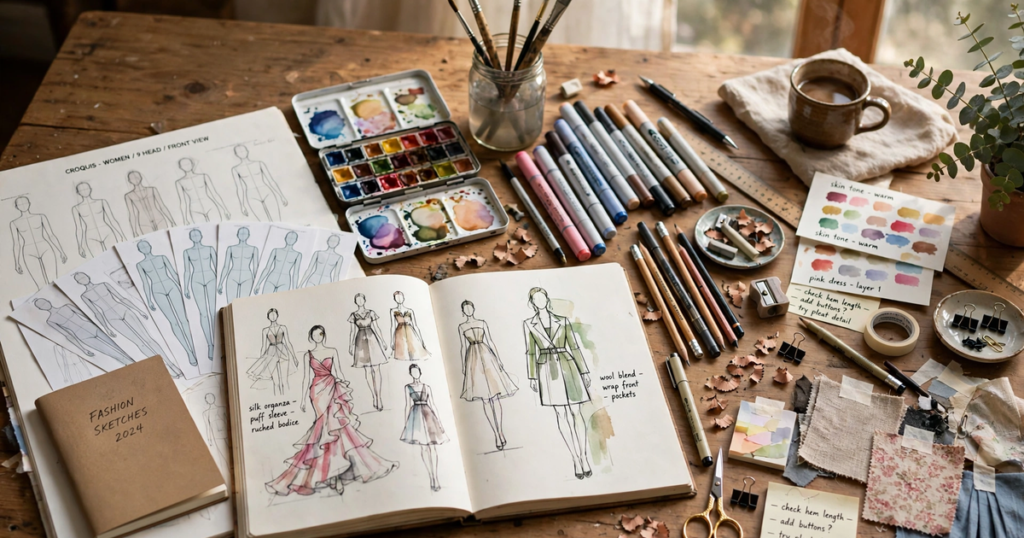
The 9-Head Figure: Drawing Proportions That Look Right
Real people measure about seven and a half heads tall. Fashion figures stretch that to nine; those long, elegant proportions are what turn an ordinary drawing into something that looks like it belongs in a lookbook.
Here is the head-unit ruler method, step by step. First, draw a small oval for the head. That oval is now your unit of measure; call it one head. Next, draw a vertical line down the page and mark nine equal units along it, each one the height of that head oval. The body landmarks fall on the lines like this:
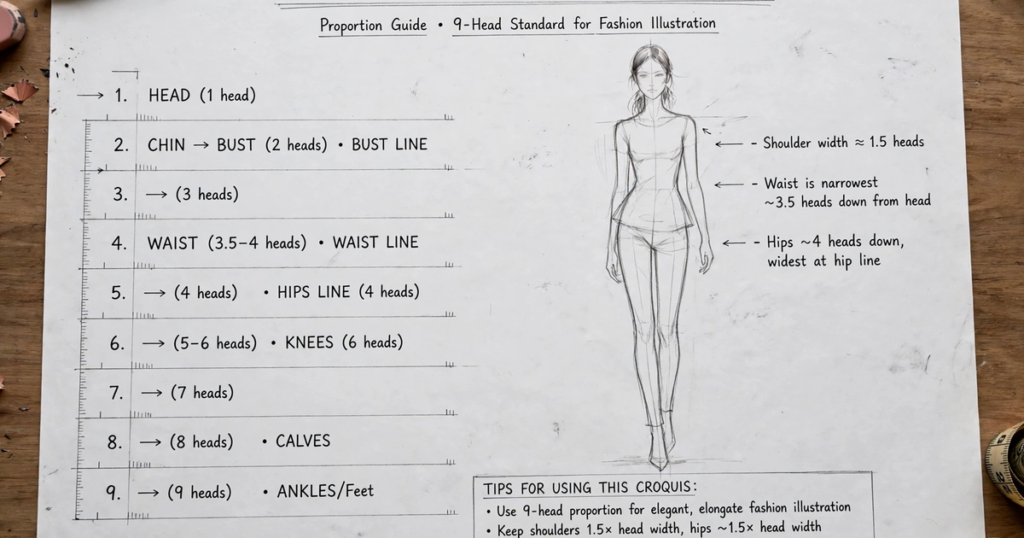
- Line 1 (the chin line): bottom of the head.
- Line 2: the bust.
- Line 3: the waist.
- Line 4: the hips.
- Just below line 4: the crotch, the widest part of the hips, sits right above it.
- Line 6: the knee.
- Line 9: the ankle, which lands on the ground.
Sketch the figure so it flows through those checkpoints instead of guessing where the waist goes. The guide lines do the measuring for you; your job is just the curves.
Common proportion mistakes
- Head too big. Beginners draw the head at a natural size, which makes everything below look stubby. Shrink the head first, and the body stretches naturally after that.
- Legs too short. The knee sits halfway between hip and ankle. If your figure looks seated while standing, add length to the legs.
- Arms too long. Relaxed fingertips reach the mid-thigh, not the knee.
- Everything is symmetrical. Stiff, mirror-image figures look lifeless. Drop one shoulder, bend one knee, and tilt the hips a little asymmetry reads as confidence.
Draw ten quick croquis from your ruler lines every morning. Within two weeks the proportions start feeling automatic. This is the single most valuable skill in fashion illustration — get the figure right and every garment you draw on it looks better.
Rendering Fabric: Markers, Watercolor, and Shading Basics
Rendering is just a fancy word for coloring your sketch so the fabric looks real. A silk dress and a wool coat cannot be shaded the same way your job is to show the difference using light and shadow.
Start with folds. Wherever fabric bends, you get a dark valley and a lit ridge. Find the tension point — an elbow, a belt, a seated knee. Fold lines radiate outward from that point like spokes on a wheel. Shadow goes in the valleys, light stays on the ridges. That one idea covers about ninety percent of believable fabric.
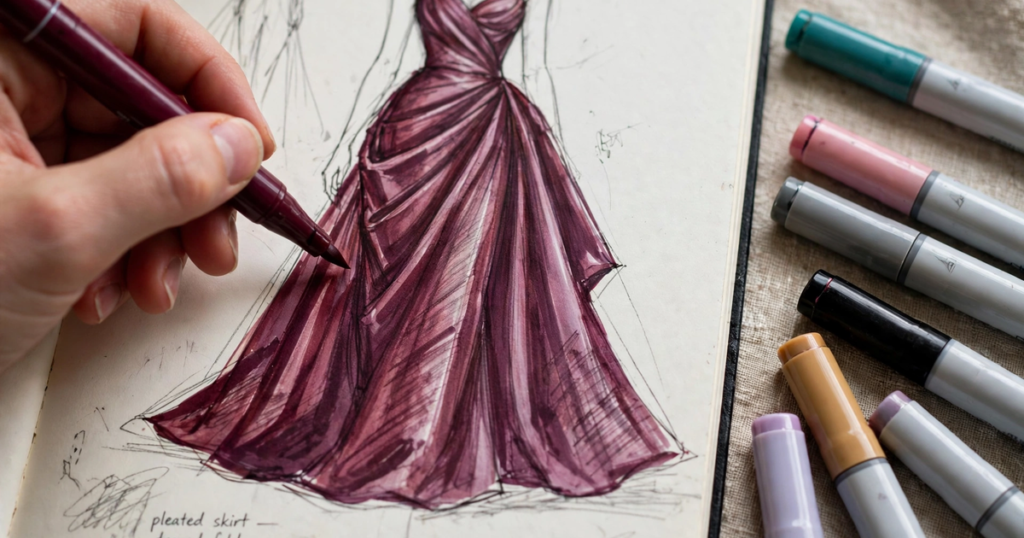
Sheen versus matte
- Shiny fabrics (satin, silk, leather): use hard-edged highlights. A crisp white streak sitting next to a deep dark shadow reads as shine instantly.
- Matte fabrics (linen, cotton, wool): keep every transition soft. Blend light into shadow gradually; there are no sharp highlights on matte cloth.
A 3-step marker layering exercise
- Step 1: Base layer: Cover the whole garment with your lightest tone in smooth, even strokes. Always stroke in the direction the fabric hangs.
- Step 2 shadow layer: add a mid-tone marker into the fold valleys. Leave the edges hard for now; do not blend yet.
- Step 3: Blend and highlight: go back over the hard edges with the light marker to soften them, then add a thin white gel-pen line on each lit ridge for pop.
Run this exercise on five swatches this week: denim, silk, leather, knit, and chiffon. You will feel the difference between sheen and matte in your hand before you ever draw a full garment, and that is exactly the point.
Digital vs Traditional: Which Tools to Learn First in 2026
Every beginner asks this, so here is the honest answer: start traditional. Pencil and paper teach you line quality, pressure, and proportion in a way no undo button ever will. Digital tools multiply your skill — they do not create it.
Once your hand knows what it is doing, here is how the options compare:
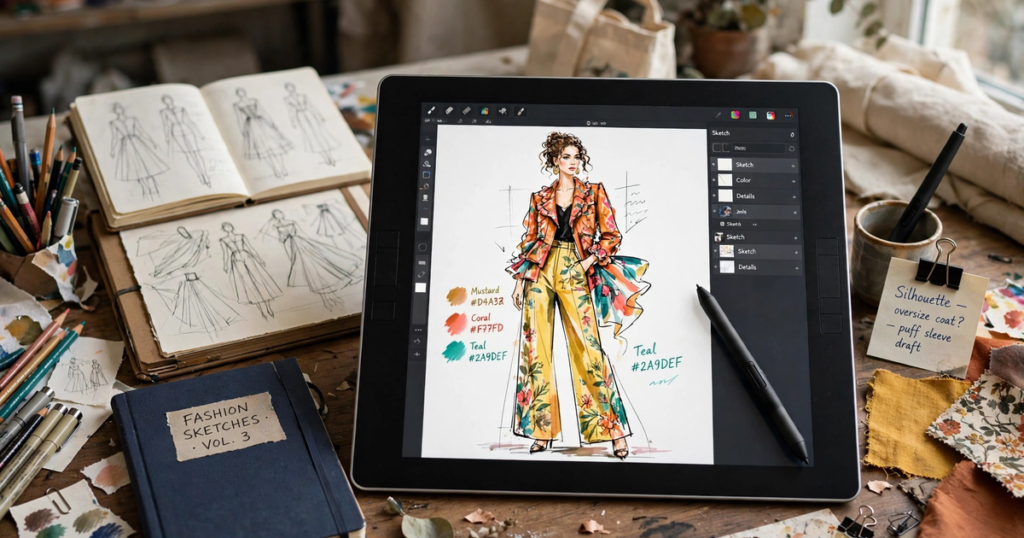
- Paper and pencils: the cheapest start — under $30 for a sketchbook, a set of 2B to 6B pencils, and a kneaded eraser. Zero learning curve and total control, but no undo, and scanning artwork is a hassle.
- Procreate on iPad: $12.99 for the app (one-time), plus the iPad and Apple Pencil. The cheapest full digital setup, with intuitive brushes that feel close to real media. The favorite of most working illustrators today.
- Adobe Photoshop: $22.99 per month on the Photography plan. The industry standard for texture work and photo manipulation, but the brush engine feels less natural for freehand drawing.
- Adobe Illustrator: $22.99 per month (or bundled in Creative Cloud). Best for clean, flat technical drawings — spec sheets, repeats, vector logos. Less enjoyable for expressive sketching.
The 2026 recommendation for absolute beginners: spend three months sketching in pencil, then move to Procreate on an iPad. That combination — traditional fundamentals plus the most affordable, intuitive digital tool — gets you confident on the digital side of fashion illustration faster than any other path. Pick up Illustrator later only if you want technical design work; it is a specialty, not a starting point.
Turning Fashion Illustration Into Income
Pretty sketches are fun. Paid sketches are better. Here are the four ways beginners actually start earning, in the order I would try them.
1. Freelance gigs on Fiverr and Upwork
Start with a $25–40 gig: a single-figure sketch drawn from a client’s photo. Buyers include boutique owners who want custom art for packaging, brides who want a sketch of their dress, and indie brands needing lookbook illustrations. Your first ten reviews matter more than your price — deliver early, over-communicate, and ask every happy client for a review.
2. Selling prints on Etsy
Turn your best sketches into printable art: fashion figure prints, nursery decor, wedding portraits. A digital download at $8–15 sells while you sleep; physical prints at $25–60 work if you use print-on-demand so there is no inventory. Niche down — “bridal fashion sketches” beats “fashion art” every time.
3. Instagram and TikTok portfolio strategy
Post one sketch a day and film the process. Time-lapse drawing videos are catnip on TikTok and Reels — a 30-second clip of a sketch coming together gets far more reach than a finished photo. Put “commissions open” in your bio with a starting price, and pin your three best pieces to the top of your profile.
4. Pricing your first commission
Charge $50–100 for a single-figure sketch when you are starting out. That covers roughly two hours of work at a fair beginner rate. Raise your price every ten commissions, or whenever you are booked out two weeks in advance — whichever comes first. Never work for exposure; if a brand cannot pay, they can buy a print.
You do not need to be the best illustrator in the world to earn from fashion illustration. You need ten solid portfolio pieces, one place clients can find you, and the nerve to name a price. Start with the gigs, stack up the reviews, and let the income grow with the portfolio.
The Future of Fashion Illustration
Fashion illustration continues to evolve with technology and creativity. Designers now combine traditional drawing with digital tools to produce modern visuals. The rise of digital fashion sketching has made it easier for artists to share their work globally. As the fashion industry grows, illustration will remain a powerful means of visual communication. Designers will continue using drawings to explain ideas, present collections, and inspire new trends.
The combination of art, technology, and design knowledge ensures that fashion illustration will always be an essential skill for future designers. Through creativity and innovation, illustrators will continue shaping the visual language of fashion.
Conclusion
Fashion illustration plays a powerful role in the fashion industry because it turns creative ideas into clear visual concepts. Designers begin with simple fashion design sketches to explore styles, shapes, and fabrics before producing real garments. Through practice and the use of different fashion sketching techniques, illustrators learn how to express clothing details, movement, and texture.
Modern designers also combine traditional drawing with digital fashion sketching tools and advanced illustration software. This combination improves creativity and accuracy during the fashion design process. Strong illustration skills also help designers communicate ideas effectively with teams through visual presentations.
What is fashion illustration?
Fashion illustration is the art of drawing clothing designs to visually represent fashion ideas before garments are produced. Designers use sketches to communicate style, fabric, and design concepts.
Why is fashion illustration important in the fashion industry?
Fashion illustration helps designers clearly convey their ideas during the design stage. It supports communication between designers, brands, and production teams.
What tools are used for fashion illustration?
Fashion illustrators use pencils, markers, watercolor paints, and digital tablets. Many professionals also use digital design software for modern illustration work.
Do fashion designers need drawing skills?
Yes, drawing skills are important because they help designers create fashion sketches, present ideas, and visualize clothing concepts before production.
How long does it take to learn fashion illustration?
Most beginners draw recognizable, attractive fashion figures within two to three months of daily practice — about thirty minutes a day on proportions and croquis. Rendering fabric convincingly takes another three to six months of marker or watercolor exercises. Reaching a professional level, the kind a brand would hire, typically takes one to two years of consistent work. But here is the encouraging part: you do not need to be professional to start earning. Many illustrators sell their first commissions within four to six months, while they are still learning. The timeline shrinks fast if you follow structured exercises like the 9-head method above instead of drawing aimlessly. Consistency beats talent every single time.
Do I need a degree to become a fashion illustrator?
No — clients buy the portfolio, not the diploma. Working illustrators come from fine art degrees, fashion schools, and plenty of self-taught backgrounds; what they share is a strong body of work. A degree gives you structure, networking, and regular critique, but a disciplined self-study plan with daily sketching and online courses can reach the same place. What actually gets you hired: fifteen to twenty polished pieces in a consistent style, process videos that prove your skill, and reviews from real clients. If you love formal education, go for it. If you do not, spend the tuition money on an iPad, quality markers, and a year of daily practice instead.
1 thought on “The Complete Guide to Fashion Illustration for Beginners and Designers”